 Satisfactory Production Planner
🇯🇵 日本語
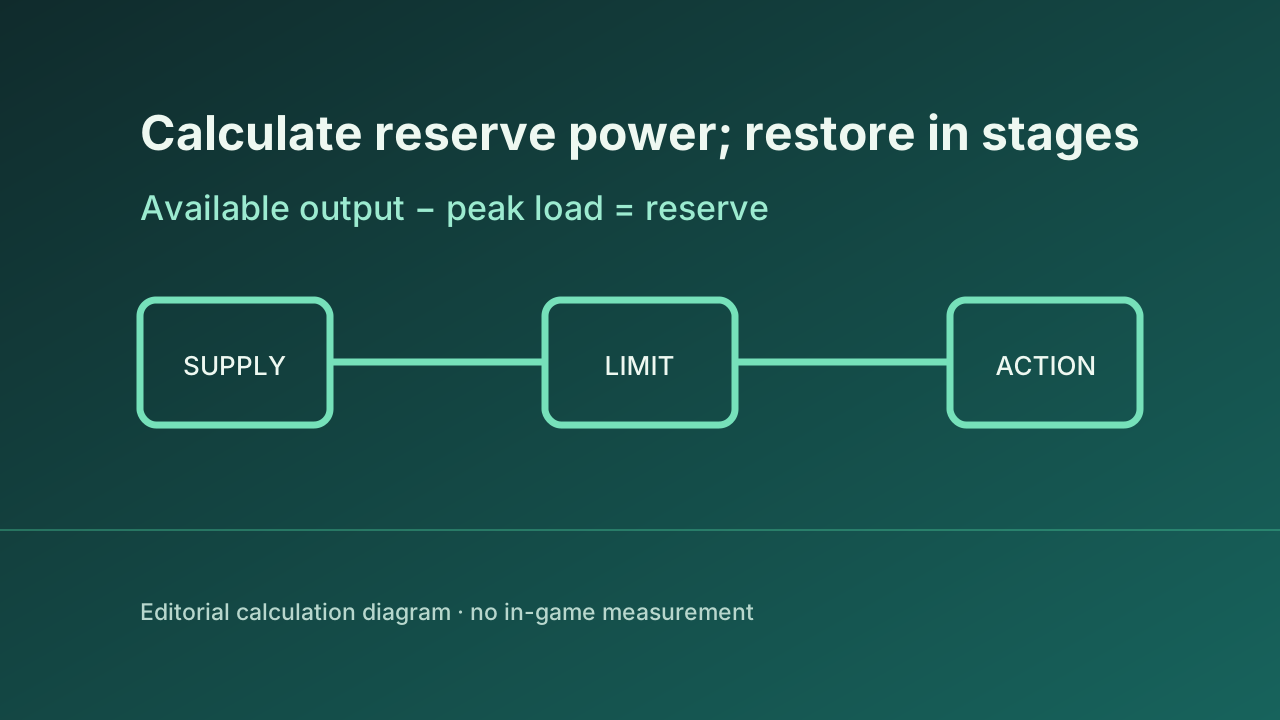
Separate rating, average load, and peak load
A generator’s combined rating is not automatically the power available to the factory. Pumps, miners, refineries, fuel processing, and other equipment that keeps generation running draw power from the same grid. Track generator rating, normal displayed consumption, and startup or variable-load peaks in separate columns.
Use headroom = available generation − all loads that can run at the same time. For example, eight generators rated at 75 MW each would total 600 MW. If auxiliaries and normal production draw 420 MW, apparent headroom is 180 MW. If a variable process can add a 240 MW peak, total demand becomes 660 MW and exceeds supply even when its average load is low. These fixed ratings are a 1.1.x model example.
| Part | Record | Check |
|---|---|---|
| Supply | Generator rating and running count | Count only units with sustained fuel, water, and inputs |
| Steady load | Mining, transport, manufacturing, pumps | Record display values while starting and stopping one area |
| Peak load | Maximum clock, variable recipes, startup | Use recipe maximums; keep them separate from averages |
| Reserve | Available generation − peak load | At zero or below, add supply or isolate loads |
Start coal power from auxiliaries outward
In the Planner’s 1.1.x example, eight coal generators at 75 MW each use 120 coal/min and 360 m³/min of water. These are not measurements from an Update 1.2 save. Check in-game recipes and equipment displays before building, and include miners, pumps, and conveyors in the load plan.
- Separate the generators from the production grid so that factories do not all restart together.
- Power coal miners and water pumps first. Confirm that water and coal reach the generator inputs at the actual pipe and belt endpoints.
- Connect a small group of generators. Add the next group only after fuel reaches them and output remains steady.
- Restore one production area at a time. If connecting an area trips the grid, measure its maximum load and auxiliaries separately.
- Before removing temporary power, confirm the miners, pumps, and conveyors that sustain generation now receive power from the new grid.
Choose recovery order by what each load supports
After a fuse trips, divide loads into generation support, essential production, and deferrable production. Disconnect deferrable areas and restore only the equipment needed to keep generation alive. Reconnecting everything to one circuit at once can trip it again during startup. Enable one area at a time and record consumption and generator state before and after each connection.
A daisy chain arranges pole connections in sequence. Treat it as a wiring layout, not a way to increase generation or power capacity. Decide which loads should disconnect together before making branches. This guide does not claim a distance limit or other rule absent from the cited update notes.
Size storage from the deficit
For a temporary shortage, required energy is deficit MW × minutes ÷ 60. A 400 MW deficit lasting 10 minutes needs about 66.7 MWh. If you assume one unit can provide 100 MWh under the bundled 1.1.x data, one would be the theoretical minimum; check starting charge, discharge output limits, changing load, and recharge time. This is a calculation example, not a tested in-game recommendation.
When measuring a deficit, record storage level and grid consumption at the same intervals. Do not count charging draw as generation headroom, and measure how long the battery actually supports the grid across an outage.
| Symptom | Compare first | Next action |
|---|---|---|
| Generators stop | Time fuel, water, or material input stops | Keep only support loads on and trace the input upstream |
| A production area trips the grid | Area peak load and simultaneous startup | Split the area and retry with a different order |
| Storage empties sooner than expected | Measured deficit, remaining charge, elapsed time | Recalculate with peak deficit instead of average |
| Grid fails only at load peaks | Variable maximum draw and headroom | Design for the maximum or isolate the variable process |
Record a reproducible check in your save
Record game version, generator type and count, recipe, clock, normal and peak demand, storage starting charge, and outage-to-recovery time. Change one variable at a time and name the success condition: generator stability, no fuse trip, or successful area reconnection. These are proposed procedures; the author has not reproduced them in the current game.