 Satisfactory Production Planner
🇯🇵 日本語
Satisfactory Production Planner
🇯🇵 日本語
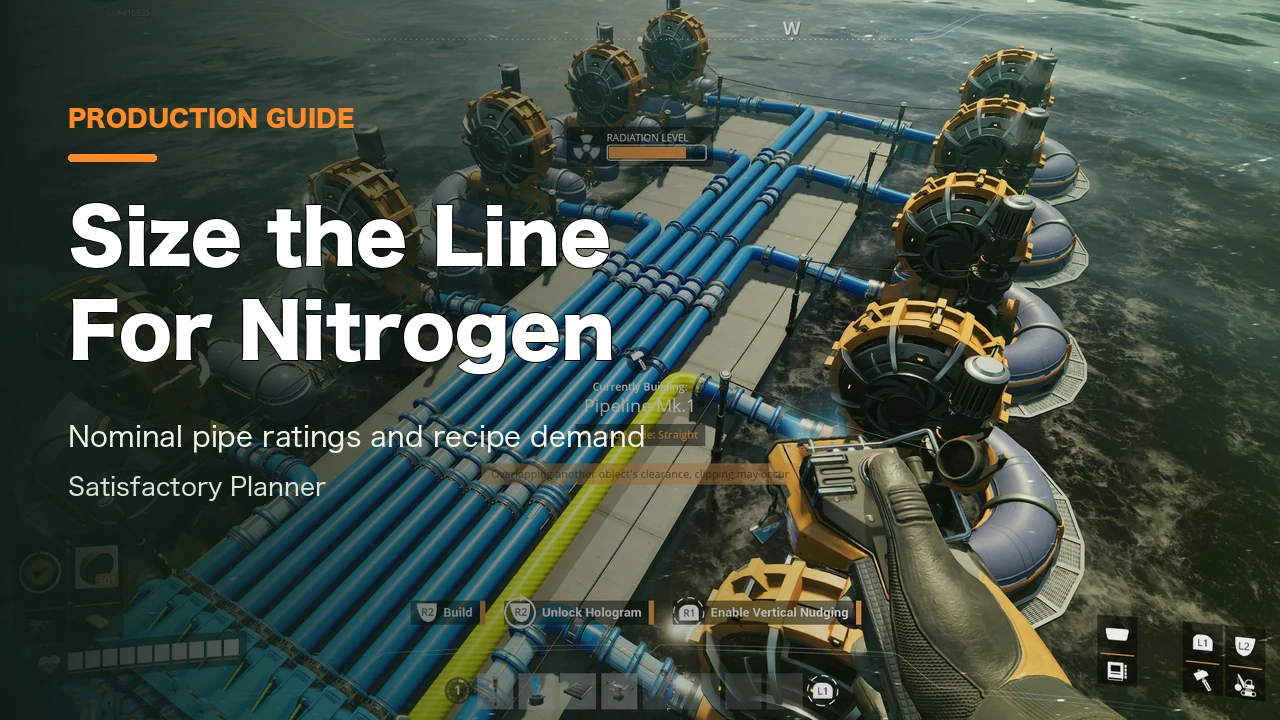
Convert one machine's recipe into per-minute rates
In the Satisfactory 1.1.x data bundled with the Planner, the Fused Modular Frame recipe makes one item every 40 seconds in a Blender. At 100% operation, that is 1.5 items per minute. Each cycle consumes one Heavy Modular Frame, 50 Aluminum Casings, and 25 units of Nitrogen Gas. Converted to per-minute rates, one Blender needs:
For N machines, Nitrogen Gas demand is 37.5 × N m³/min. Aluminum Casing demand is 75 × N items/min, and Heavy Modular Frame demand is 1.5 × N items/min. These are not live in-game measurements; they convert the bundled recipe into continuous rates at 100% clock.
- Heavy Modular Frame: 1.5 items/min
- Aluminum Casing: 75 items/min
- Nitrogen Gas: 37.5 m³/min
- Fused Modular Frame: 1.5 items/min
Compare demand with nominal pipeline capacity
The bundled data lists 300 m³/min for Pipeline Mk.1 and 600 m³/min for Pipeline Mk.2. Dividing each value by recipe demand gives these idealized ceilings:
The calculation is pipe capacity ÷ 37.5. If all 16 machines use the nominal 600 m³/min of a Mk.2 line, calculated nitrogen demand is also 600 m³/min, leaving no nominal headroom. Fifteen machines use 562.5 m³/min, leaving 37.5 m³/min in the simple calculation. Eight machines on a Mk.1 line also use its full 300 m³/min.
Do not treat a ceiling-rate machine count as a recommended count. Set a reserve based on actual supply, other consumers on the network, and machine operation. If other consumers share the supply, add their nitrogen demand before comparing it with pipe capacity.
| Nitrogen supply assumption | Calculated Blender limit | Fused Modular Frame | Aluminum Casing | Heavy Modular Frame |
|---|---|---|---|---|
| Mk.1: 300 m³/min | 8 machines | 12 items/min | 600 items/min | 12 items/min |
| Mk.2: 600 m³/min | 16 machines | 24 items/min | 1,200 items/min | 24 items/min |
Check the other recipe inputs too
Securing nitrogen alone does not guarantee the planned production rate. For example, the 16-machine ceiling for the Mk.2 calculation also requires 1,200 Aluminum Casings and 24 Heavy Modular Frames per minute. When building the plan, enter each upstream supply as a per-minute rate and check whether shared resources can cover it.
The Planner calculates per-minute inputs, machine equivalents, and item balances from its bundled recipes. It does not simulate finite nitrogen storage or live pipe flow, head lift, splits, or merges. A plan that fits the nominal pipeline rating does not, by itself, show that a real pipe network will deliver the same flow consistently.
How this differs from existing articles
The published Aluminum Production and Aluminum Water Loop articles cover Alumina Solution production and water by-product use. This draft does not repeat those processes; it treats finished Aluminum Casing as an input rate for Fused Modular Frame production. Draft 010, “Pipeline Flow and Head Lift Troubleshooting,” isolates general flow problems. This article is a capacity-planning calculation: it works backward from the 1.1.x recipe to estimate a machine count from nitrogen supply and then checks the other input demands.
Recipes, transport ratings, and version scope
Related guides
Try it in the planner
Opens the planner with the conditions from this guide already loaded. Target rates and the recipes you allow can be changed once it is open.
Check these rates in a production plan